
Foundations
How do travel creator campaigns work for England tourism brands?
Travel creator campaigns in England: who buys them, how buying routes compare, what the ASA and ICO rules require, and how to build briefs and budgets for 2027.
What to take away
- Travel creator campaigns in England are bought mainly by destination bodies, attractions, transport operators and hospitality groups, with VisitEngland behind the national promotional effort.
- Four buying routes existdirect with a creator, through a creator agency, through a marketing agency, or via a platform marketplace. Each trades control against speed.
- Disclosure is not optional. The ASA treats payment in kind like cash, so a gifted trip still needs a clear label.
- Creator work sits inside UK GDPR. The rules cover the personal data you collect when you brief, contract and pay someone.
- Budgets are built from components rather than a day ratecreator fee, usage rights, exclusivity, expenses and paid amplification.
What counts as a travel creator campaign
A travel creator campaign is a paid or gifted arrangement in which a content maker produces travel material for a brand that has some control over the brief. The output usually runs on the creator's own channels first, then gets reused in paid media, on the brand's site or in print.
Is it a creator campaign?
Did the brand control or approve the brief?
Paid marketing communication, rules apply
Press trip, generally not covered
The definition matters because it decides which rules apply. A one-off gifted stay with no brief is still a marketing communication if the brand had approval over what was posted. A press trip with no conditions attached generally is not.
Buyers in England usually sit in one of four places: a destination management organisation, a visitor attraction, a transport or accommodation brand, or an agency buying on behalf of one of those. Each has a different approval chain and a different view of what success looks like.
On the supply side, most creators are sole traders or run small limited companies. The ONS publishes the UK's official employment and self-employment counts in its Employment and employee types release, and that dataset is the only workforce figure a planner can cite without guessing.
Who buys this work in England
Destination management organisations are the most visible buyers. They commission creator content to fill seasonal gaps, launch new routes and support shoulder-month demand. Their budgets often come from a mix of local authority funding and commercial partnership income. Marketing Manchester, Visit Cornwall and the NewcastleGateshead Initiative are three England destination bodies in this group.
Four buyer types in England
DMO
- Goal
- Fill seasonal gaps
- Campaign length
- Longer, seasonal
- Success measure
- Reach and demand
- Approval speed
- Slow, board and council
Attraction or hotel
- Goal
- Drive bookings
- Campaign length
- Short, event-tied
- Success measure
- Bookings
- Approval speed
- Fast, one morning
Transport operator
- Goal
- Reduce friction
- Campaign length
- Route or ticket explainers
- Success measure
- Usage and clarity
- Approval speed
- Medium
VisitEngland is the national body with responsibility for growing the domestic tourism market and supporting the sector's recovery and growth, as set out in its official role and responsibilities. It does not buy every campaign, but its priorities shape what regional bodies commission.
VisitEngland's own domestic campaigns, such as Escape the Everyday, set the themes that regional bodies then repeat in their creator briefs.
Attractions and hospitality groups buy closer to the point of sale. Their campaigns tend to be shorter, tied to a specific opening, menu or event, and measured in bookings rather than reach. Transport operators buy content that reduces friction, such as explaining a route or a ticket type to people who have never used it.
The Eden Project in Cornwall is a typical attraction buyer, briefing around a season or a new exhibit. Transport buyers include Transport for London, LNER on the East Coast Main Line and National Express.
The digital advertising industry around all of this is substantial. IAB UK is the trade body for that industry, and it is where most creator media budgets are planned and traded.
Approval chains matter as much as budgets. A destination body may need sign-off from a board and a local authority partner, while an independent attraction can approve a concept in a morning. Ask who signs the contract before you shape the idea.
How the market is structured
Most campaigns take one of four routes. The first is direct, where a brand contracts a creator it already knows. The second is through a creator agency or talent manager. The third is through a marketing agency that keeps a roster of creators. The fourth is a platform marketplace that matches brands to creators and handles contracting.
Four buying routes compared
Direct
- Contract
- Simple services deal
- Best for
- One local creator
- Speed
- Fast
- Trade-off
- Limited scale
Creator agency
- Contract
- Adds a layer
- Best for
- Multi-creator rights
- Speed
- Medium
- Trade-off
- Slower decisions
Marketing agency
- Contract
- Adds a layer
- Best for
- Paid media campaigns
- Speed
- Medium
- Trade-off
- Slower decisions
Marketplace
- Contract
- Platform handles it
- Best for
- Low-risk trials
- Speed
- Fast
- Trade-off
- Takes a cut
Direct deals are common at the smaller end, where a single attraction works with a local creator. Agency routes dominate once a campaign needs several creators, consistent usage rights or paid amplification behind the organic posts.
Marketplaces reduce admin but take a cut, and they rarely suit campaigns that need a strong editorial point of view.
Route choice also affects the contract. Direct deals are usually a simple services agreement. Agency routes add a layer, which can slow decisions but gives you a single point of accountability.
Platforms move faster than contracts. Vertical short-form video has been the format buyers ask for most in recent years. For 2027 briefs, write deliverables by format and length rather than by platform name. A single shoot then still works if the platform mix shifts.
For a worked comparison of the routes and their trade-offs, the market entry checklist sets out what to confirm before signing anything.
Demand signals worth tracking
Demand for creator content in England is not evenly spread. It clusters around coastal towns in summer, cities for food and culture, and rural areas for walking and wellness. Each cluster has its own booking patterns and its own tolerance for creator content.
The Great Britain Day Visits Survey, run across England, Scotland and Wales, is where those clusters show up, split by trip purpose and season.
Shoot timing versus launch
- February shootJuly launch, months of usable assets
- July shootAugust launch, only days of assets
Seasonality is the biggest single factor. A campaign shot in February for a July launch gives a brand months of usable assets. A campaign shot in July for an August launch gives it days.
For a summer 2027 launch, the booking window generally opens in the first quarter, so the shoot has to land before it does.
Search and social interest in short-form travel video has changed what buyers ask for. Vertical video, first-person narration and practical detail now outperform polished destination films for conversion, though the polished film still has a role in brand campaigns.
Regional bodies also publish their own visitor research, and reading it before you pitch is a cheap way to look informed. Booking curves from the previous year are more useful than forecasts, because they show when demand actually formed.
VisitEngland's Annual Survey of Visits to Visitor Attractions gives the national attraction picture. The Association of Leading Visitor Attractions publishes annual visitor numbers for its members, which is the closest public benchmark for an individual site.
Booking curves are rarely published nationally. They sit with the operator or its booking system, so ask the client for theirs rather than relying on a sector forecast.
The demand signals in England piece tracks where those clusters are strongest and how to read them before committing budget.
Rules that shape campaign design
Advertising rules apply to creator content in the same way they apply to any other marketing communication. The ASA's AdviceOnline library covers influencer recognition and disclosure, including what counts as a payment and how ads must be labelled.
Compliance checks before briefing
- Label the ad so a viewer recognises it
- No buried hashtags as disclosure
- State lawful basis for creator data
- Add sector rules to the brief
- Agree retention for campaign analytics
In practice this means the commercial relationship has to be obvious. A simple label naming the post as an ad works. Buried hashtags do not. The test is whether a reasonable viewer would recognise the content as advertising without having to look for clues.
Data protection sits alongside this. When you brief a creator, collect their bank details or run analytics on campaign performance, you are processing personal data. The ICO's UK GDPR guidance and resources explain the lawful bases, retention rules and individual rights that apply.
There is a third layer for regulated sectors. Alcohol, gambling, financial services and some health claims carry extra restrictions that a creator may not know. Put those in the brief, not in a follow-up email.
Rules can change between the brief and the post. Check the ASA's AdviceOnline and the ICO's current guidance before a 2027 campaign goes live rather than working from a saved 2025 template. Allow extra review time if the campaign touches a regulated sector or an audience that includes children.
What a campaign brief should contain
The brief is where most campaigns succeed or fail. It should state the objective in one sentence, the audience, the deliverables, the deadline and the disclosure requirement. Anything missing becomes a negotiation later.
What the brief must state
- Objective in one sentence
- Audience and deliverables
- Deadline and disclosure wording
- Maximum approval turnaround
- Usage rights and exclusivity terms
Deliverables need to be specific. A brief might ask for three vertical videos, one carousel and five stills with twelve months of paid social rights. Asking for some content from the trip is not a brief.
Approval should be time-boxed. A creator waiting three days for sign-off on a time-sensitive post loses reach, and the brand gets a worse result. Agree a maximum turnaround in the contract.
Usage rights are the most commonly underpriced line. Organic posting rights, paid media rights, perpetual rights and exclusivity are four separate things, and each should carry its own fee.
Budgets and how they are built
There is no published rate card for travel creator work in England. Fees are negotiated, and they vary with audience size, niche, deliverable count, usage and exclusivity.
Illustrative budget components
- £400monthly retained creator fee
- £1,200single campaign with 12-month paid rights
- 12 monthspaid media rights window
Start with a real example. A team paying £400 a month for a retained creator on a local attraction account buys a fixed number of posts and a set usage window.
The same creator might quote £1,200 for a single campaign with twelve months of paid media rights. Both figures are illustrative.
The same logic scales across bigger campaigns. Three illustrative scenarios show the four lines working together; the ranges below are typical planning figures, not quotes.
| Scenario | Creator fee | Usage | Exclusivity | Paid amplification |
|---|---|---|---|---|
| One attraction, one creator | £800 to £1,500 | Twelve months of paid social | None | £500 to £1,500 behind the top post |
| Regional destination body, three creators | £2,500 to £6,000 in total | Twelve months of paid media, England only | Campaign window only | £5,000 to £15,000 across the flight |
| National transport brand, one creator and a shoot day | £4,000 to £10,000 | Twenty four months of paid media plus brand site rights | Six months, travel category | £20,000 and above, agency managed |
Production costs sit on top. Travel, accommodation and expenses are often covered in kind, which is a payment for disclosure purposes even when no cash changes hands. Account for it in the budget and in the label.
Paid amplification behind creator content is a separate line and often the largest one. A modest creator fee with a strong paid budget will usually outperform a large fee with no media behind it.
The costs and budget guide for England breaks these components down into a format you can take into a planning meeting.
Comparison of the main buying routes
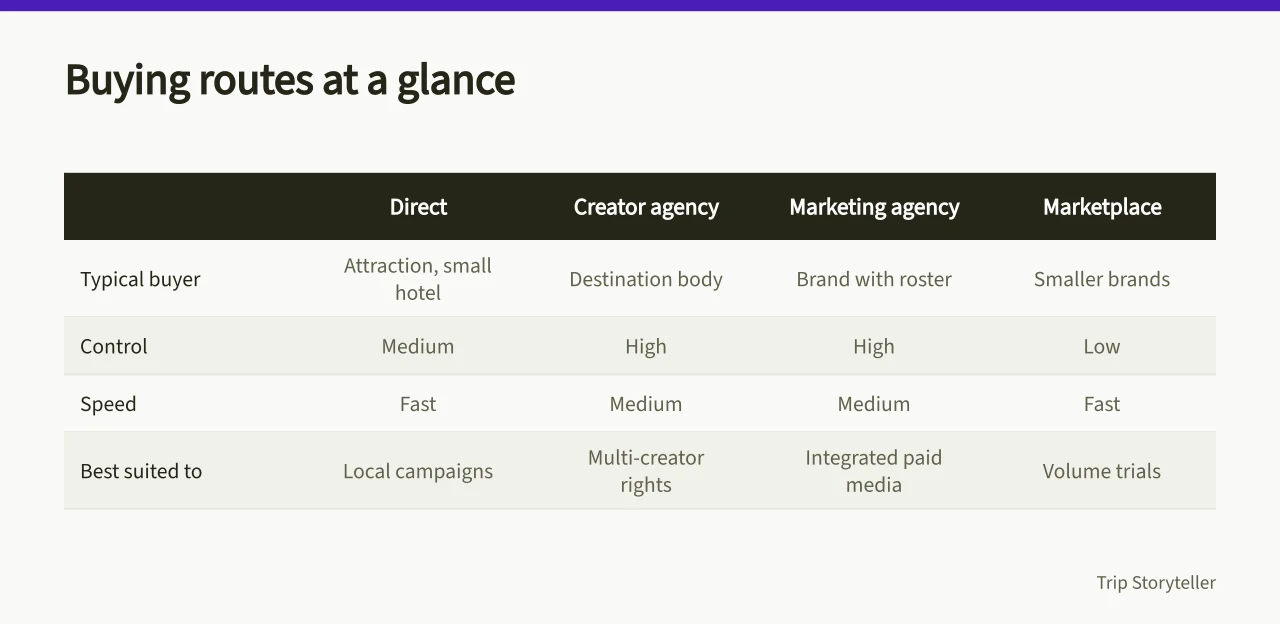
Routes differ on four practical measures: control over the output, speed to publish, total cost and admin load.
Control
- Direct with a creator
- Highest, because you brief and approve the creator yourself
- Creator agency
- Shared, because the agent briefs and may filter ideas
- Marketing agency
- Lower on editorial detail, higher on integration with paid media
- Platform marketplace
- Lowest, because the format follows the platform template
Speed
- Direct with a creator
- Fastest, with one conversation and one contract
- Creator agency
- Medium, since the agent sits between both sides
- Marketing agency
- Slowest, because approval layers stack up
- Platform marketplace
- Fast on paper, slower once the brief needs changes
Cost
- Direct with a creator
- Creator fee only, with no agency margin
- Creator agency
- Creator fee plus agency commission
- Marketing agency
- Highest, since strategy, media and margin are included
- Platform marketplace
- Creator fee plus a platform cut
Admin
- Direct with a creator
- You handle contracting, usage terms and payment
- Creator agency
- Contract and payment sit with the agency
- Marketing agency
- Single point of contact across several creators
- Platform marketplace
- Least admin, with standard terms and built-in payment
For a 2027 summer campaign, the route decides whether the shoot can happen in the first quarter. Direct and creator agency routes usually can, while marketing agency and marketplace routes often cannot.
Measuring whether it worked
Reach and engagement are the easiest numbers to report and the least useful on their own. They tell you the content was seen, not that it changed anything.
Better measures sit closer to the booking. Tracked links, unique codes, branded search lift and assisted conversions all give a clearer picture. None is perfect, and the honest approach is to agree two or three measures before the campaign starts.
Attribution windows need agreeing in advance too. A thirty-day click window and a ninety-day view window will produce very different numbers from the same campaign, so state which one you are reporting against.
Brand-side measures matter as well. A campaign that produces twelve months of reusable assets has value beyond the posts themselves, and that value should be recorded somewhere.
Set targets against a segment estimate rather than a national average, and the market size in England article explains how to build one.
Contracts, payment and tax basics
Most creators working with England-based brands operate as sole traders or through a limited company. The contract should name the entity that is being paid, not just the person posting.
Payment terms are a frequent friction point. Thirty days from invoice is standard in agency work; smaller creators often expect faster. Agree it in writing before the trip.
Tax treatment depends on how the creator is set up and whether they are UK resident. Brands should not give tax advice, but they should be clear about whether fees are quoted inclusive or exclusive of VAT.
Exclusivity clauses deserve attention. A six-month exclusivity restriction on a creator who works across the travel sector can cost them far more than the fee. Reflect that cost in what you pay.
Insurance and liability for anything that happens on a trip is a separate question, and the contract should say who carries it.
Where the commercial opportunity sits
The commercial opportunities piece maps the segments where creator content is underused, including off-season city breaks and accessible travel.
Accessible travel is a clear gap. Creators who can speak credibly about step-free access, sensory considerations and assistance at stations reach an audience that mainstream destination marketing often misses.
Shoulder-season campaigns are the other obvious gap. Coastal and rural businesses have inventory to fill outside July and August, and creator content can be scheduled to land in the booking window rather than the travel window.
Common questions
Do gifted trips count as advertising?
Yes, if the brand had any control over the content or the creator was given something of value in exchange for posting. The ASA treats payment in kind the same as cash for recognition purposes, so the content still needs a clear label.
Who regulates travel creator campaigns in England?
Advertising content is regulated by the ASA under the CAP Code, and personal data handling is regulated by the ICO under UK GDPR. Destination marketing at national level sits with VisitEngland, which has no enforcement role over individual campaigns.
How long should usage rights run?
There is no fixed rule. Twelve months of paid media rights is a common starting point for a seasonal campaign, with perpetual rights priced separately and usually much higher. Match the term to how long you realistically expect to use the assets.
Can a creator be paid only in commission?
It is possible, but it is a hard sell for established creators and it still counts as a commercial relationship for disclosure. If the only payment is a share of bookings, the label requirement does not disappear.
In this guide
- Estimate travel influencer campaign spend in England before quotingTravel influencers in England have no single published campaign budget. Build a defensible estimate from ONS data, VisitEngland and local authority spend.
- What travel creator campaigns demand signals mean for England's visitor economyA practical list of the demand signals that decide travel creator campaigns in England, from booking intent and search interest to tax, consent and reuse rights.
- Comparing the main travel creator campaign business models for England operatorsCompare flat fee, retainer, affiliate and gifting travel creator campaign models, with illustrative costs, a scoring rubric and payment terms for England operators.
- Travel creators: a market-entry checklist for tourism teamsAn England market-entry checklist for travel creators and tourism teams, covering ad labels, creator agreements, consent, pilot budgets and measurement.
- Five commercial opportunities travel creator campaigns open up for UK brandsA practical look at where UK travel creator campaigns pay off commercially, from paid distribution and affiliate deals to licence fees and tourism briefs.